Benedict XVI bid farewell to the Italian Alps and those who helped him to make his holiday a pleasant one, but not before taking a light-hearted jab at his Guardian Angel for not keeping his vacation injury-free.
Benedict XVI bid farewell to the Italian Alps and those who helped him to make his holiday a pleasant one, but not before taking a light-hearted jab at his Guardian Angel for not keeping his vacation injury-free.
Vatican City, July 31 (CNA) .- Today, the Vatican published Pope Benedict's prayer intentions for August. The Pope will be praying for refugees and for those who are persecuted in Christ's name.

The Holy Father, Pope Benedict XVI
Pope Benedict's general prayer intention for August is "That public opinion may be more aware of the problems of millions of displaced persons and refugees, and that concrete solutions may be found for their often tragic situation."
His mission intention is "That those Christians who are discriminated against and persecuted in many countries because of the name of Christ may have their human rights, equality and religious freedom recognized, in order to be able to live and profess their own faith freely".

Prime Minister Stephen Harper has blamed the controversy of his recent reception of Holy Communion on “people who want to cause embarrassment in religion and drive a wedge between Protestants and Catholics.”
“While I’m not theologically a Catholic, in my judgment, the Catholic Church is a critical bulwark of worldwide Christianity,” Harper added. “The Pope is an important moral and spiritual leader generally and for Christians generally, even though I’m not a Catholic.”
Source: Catholic Culture
It was reported earlier that the Canadian Prime Minister Stephen Harper accepted and ate a communion wafer at a Catholic mass and didn't pocket it as critics have alleged, according to his spokesman.
Harper, a devout Protestant, attended last week's state funeral for Canada's former governor general, Romeo LeBlanc, during which a Catholic priest offered him a communion host. READ HERE


“This afternoon, Friday 10 July 2009, His Holiness Pope Benedict XVI received in Audience the President of the United States of America, His Excellency Mr. Barack H. Obama. Prior to the Audience, the President met His Eminence Cardinal Tarcisio Bertone, Secretary of State, and also His Excellency Archbishop Dominique Mamberti, Secretary for Relations with States.“In the course of their cordial exchanges the conversation turned first of all to questions which are in the interests of all and which constitute a great challenge for the future of every nation and for the true progress of peoples, such as the defense and promotion of life and the right to abide by one’s conscience.“Reference was also made to immigration with particular attention to the matter of reuniting families. “The meeting focused as well upon matters of international politics, especially in light of the outcome of the G8 Summit. The conversation also dealt with the peace process in the Middle East, on which there was general agreement, and with other regional situations. Certain current issues were then considered, such as dialogue between cultures and religions, the global economic crisis and its ethical implications, food security, development aid especially for Africa and Latin America, and the problem of drug trafficking. Finally, the importance of educating young people everywhere in the value of tolerance was highlighted.”
VATICAN CITY – Prime Minister Stephen Harper praised Pope Benedict XVI as a moral and humanitarian leader after a private audience at the Vatican yesterday.
"It was an honour to meet Pope Benedict and hear his perspective on a number of important issues, including human rights and an ethical response to the global economic crisis," Harper said in a written release.
"I expressed my deep appreciation for the Holy Father's moral and humanitarian leadership as an advocate of human dignity, peace and religious liberty, and for the spiritual leadership he provides to Catholics in Canada and throughout the world."
Harper's wife, Laureen, and his children Ben and Rachel joined the Prime Minister and the pontiff after the private audience. The family later viewed the tomb of John Paul II and the ancient tomb of St. Peter.
It was reported earlier that the Canadian Prime Minister Stephen Harper accepted and ate a communion wafer at a Catholic mass and didn't pocket it as critics have alleged, according to his spokesman.
Harper, a devout Protestant, attended last week's state funeral for Canada's former governor general, Romeo LeBlanc, during which a Catholic priest offered him a communion host.
Television images, some of which have been posted on YouTube, showed Harper receiving the host. The camera remained on the premier for several seconds but it did not show him actually place the wafer into his mouth.
A priest holds a Holy Communion wafer
"At the end of the service, he was offered communion. He accepted communion and he consumed it," Dimitri Soudas said Wednesday, quoted by Canadian media.
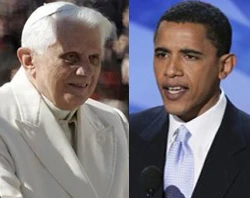
In advance of Pope Benedict's meeting with President Barack Obama on July 10, several major American media outlets advanced the theme that the Pontiff, unlike some American bishops, was likely to show sympathy for Obama's political approach.
However, a Vatican statement released soon after the Friday meeting indicated that the Pope had spoken directly into a discussion of issues involving the sanctity of human life, on which Obama differs markedly from the Catholic Church. The Vatican said that the "cordial" conversation "turned first of all to questions which are in the interests of all and which constitute a great challenge for the future of every nation and for the true progress of peoples, such as the defense and promotion of life and the right to abide by one’s conscience."

The conversation also touched upon embryonic stem-cell research, and the Pope gave his guest a copy ofDignitas Personae, the Vatican document that explains the Church's teaching on cloning, stem-cell research, and in vitro fertilization. Obama promised to read the document during his flight to Ghana.
The Pontiff and the American president also spoke about the quest for peace in the Middle East, concern for the environment, and efforts to relieve poverty.
Father Federico Lombardi, the director of the Vatican press office, told reporters that the Pontiff was impressed by the American president. Father Lombardi emphasized in his own comments to reporters that President Obama had spoken at length about his commitment to reduce the number of abortions performed in the US. Thus the papal spokesman-- who has issued public statements reducing the force of papal pronouncements on several recent occasions-- delivered the message that the White House had clearly hoped to convey to the world's media.
President Obama reportedly gave Pope Benedict a private letter from Senator Edward Kennedy. Although the contents of that letter were not disclosed, Obama did ask the Pope's prayers for Kennedy, who is suffering from a brain tumor.
Source(s): these links will take you to other sites, in a new window.

.- Knights of Columbus leader Carl Anderson has expressed his hopes that the meeting between U.S. President Obama and Pope Benedict XVI this Friday will be a "wonderful opportunity" for sharing the Catholic faith. In an interview with CNA, Anderson said that the meeting will be a chance for the Pontiff to clearly explain Church teaching on a wide range of topics.
"I think it is always a wonderful opportunity when a Head of State meets with the Holy Father," Anderson told CNA. "Obviously, the relationship between the United States and the Vatican is very important, is very complex," he noted.
Anderson said that the upcoming meeting "provides the Holy Father with an opportunity to make clear why the Church’s teaching covers a broad spectrum, why it arises from a consistent ethic and a consistent view of the person, and why it is that those in public policy, such as the President, whether he’s a Democrat or a Republican, should try to understand the foundation for the Church’s teaching."
He went on to explain that if politicians and public figures understand this crucial foundation, hopefully they can then "understand what’s built upon the foundation, specific ethical positions or recommendations."
Anderson is hopeful that the meeting will allow the Pope to share the truths of the Catholic faith with Obama, whose early months in office have given him a reputation for violating Church teaching on fundamental issues such as abortion, same-sex "marriage" and embryonic stem cell research.
"A new president represents new opportunities," Anderson told CNA. "He has a new chance to chart different kinds of discussions on health care, immigration, peace, dealing with the Middle East situation."
He added that the Vatican should "encourage a consideration of those kinds of issues from the perspective of Catholic social doctrine, as well as fundamental issues such as abortion and the role of population control in foreign policy and economic development."
Nonetheless, Anderson stressed the idea that all these social issues are connected, pointing to Benedict’s new encyclical, "Caritas in veritate" (Charity in truth). He explained, "The Pope makes very clear that authentic economic development, human development must include respect for the unborn child, respect for the institution of marriage as between a man and a woman, and hopefully they will have the opportunity to speak at length about those issues."
"It’s not enough that we respect those who disagree with us," Anderson concluded, explaining that we need to "make clear the teaching of the Church in a way that’s respectful, but nonetheless in a way that we hope will be persuasive."

A statue depicting a nun is presented to Pope Benedict XVI during Kevin Rudd's visit to the Mary MacKillop Chapel in Sydney

Opposition front-bencher Christopher Pyne hit out at Rudd's plan to raise the canonisation of nun Mary MacKillop during this week's Vatican meeting with Pope Benedict XVI.
"The sheer arrogance of the prime minister, believing he can lobby the Pope on behalf of Mary MacKillop, is quite frankly offensive," Pyne told Sky News.
"The path to sainthood is a very serious process and it doesn't include lobbying by the leaders of countries," he added.
Opposition heavyweight Tony Abbott had earlier accused Rudd of pushing the sainthood in the same way that Australia is bidding to hold the 2018 and 2022 football World Cups.
But Labor MP David Bradbury said there was no suggestion that Rudd, a Catholic, would produce evidence of the miracle needed to turn MacKillop into a saint.
"There's no suggestion here that the prime minister is somehow going to pull out the key piece of evidence when it comes to deciding whether to make Mary MacKillop a saint," he said.
"The issue is that Mary MacKillop was a great Australian, a great Catholic, and someone who presents this nation's best opportunity to have a saint," he added.
MacKillop was born in the southern state of Victoria in 1842 and founded the Sisters of St. Joseph, which opened schools and charitable institutions.
She was beatified in 1995 after the Vatican agreed that prayers to her in 1961, some 52 years after her death, had saved a woman from cancer.
MacKillop needs one more approved miracle to become a full saint.

| Bystanders look at the debris caused by a bomb blast outside the Immaculate Conception Cathedral in Cotabato City yesterday. AP |
Vatican City, Jul 5, 2009 (CNA).- This morning in the Filipino town of Cotabato City, a bomb was detonated near the Cathedral of the Immaculate Conception, killing at least five people and wounding some 34 others. After praying the Angelus at the Vatican, Pope Benedict XVI expressed his "deep rejection" of the attack and prayed for the victims.
The Holy Father explained that the attack is being attributed to Muslim extremists by the local police. The Pope told the faithful gathered in St. Peter's Square, "the explosion of a bomb in front of the cathedral (Cotabato) during the celebration of Sunday Mass, has caused several deaths and numerous injuries, including some women and children."
"While praying for the victims of this ignoble gesture, I raise my voice once again to condemn the use of violence, which is never a decent way to solve problems," he added.
Hundreds of churchgoers remained inside the cathedral after the powerful explosion, praying even more fervently for “peace.” The Catholic Bishops' Conference of the Philippines (CBCP) said that Cotabato Archbishop Orlando Quevedo was delivering his homily when the incident occurred, causing panic among churchgoers.
Rolando Emberga, a churchgoer, said some rushed to go out of the church, but Archbishop Quevedo tried to calm things down, the CBCP reports.
Emberga said the blast was extremely loud and that people inside the church were screaming.
Four people, including two soldiers, died instantly in the attack and a fifth victim died at the hospital, according to local police reports.
Source: EWTN
Death toll in Cotabato bombing rise to 6
Updated July 06, 2009 11:01 PM
COTABATO, Philippines (Xinhua) - The death toll in the roadside bombing yesterday morning outside a Catholic church in the restive southern Philippines rose to six today, local media reported.
Baby boy Jeffrey Sayrel, 1, who was critically injured, died on Monday afternoon at a hospital in the southern city of Cotabato, Edwin de Gracia, parish priest of the Immaculate Conception Cathedral, told a local radio station.
"The doctors tried but due to severe shrapnel wounds in the body, the boy died," Gracia said.
Five people were killed on Sunday and 55 others were wounded when militants detonated a home-made bomb in front of the church.
"We were inside the church when the blast happened outside. Three of my kids were hit by shrapnels and Jeffrey was among ( those) in serious condition," Lanny, the boy's mother, told Xinhua.
"I'm angry with the attackers. I hope they will be captured by the authorities," she added.
Earlier, the military said perpetrators behind the bomb attack were believed to be trained by foreign militants hiding in the country.
US troops in the Philippines are helping the authorities to investigate the bomb attack.

VATICAN CITY (AP) — Cardinal John Henry Newman, an influential 19th-century Anglican theologian who converted to Roman Catholicism, moved a step closer to possible sainthood Friday after the pope approved a miracle attributed to his intercession.
Pope Benedict XVI ruled that the recovery of a Boston-area resident who for years suffered from a spinal disorder was miraculous, meaning Newman can now be beatified. A second miracle is necessary for him to be declared a saint — an event which, if it happens, would make Newman the first English-born saint since the Reformation.
Newman, a hero to many Anglicans and Catholics alike, was one of the founders of the so-called Oxford Movement of the 1830s, which sought to revive certain Roman Catholic doctrines in the Church of England by looking back to the traditions of the earliest Christian church. Anglicans split from Rome in 1534 when English King Henry VIII was refused a marriage annulment.
"He was extraordinarily important in helping the Anglican church in finding its identity," said Cynthia McFarland, managing editor of the Anglicans Online Web site.
In 1841, Newman published a paper demonstrating that the Thirty-Nine Articles, the doctrinal statements of the Church of England, were consistent with Catholicism. Amid outcry from Anglicans, Newman retired and in 1845 joined the Roman Catholic Church. A year later he was ordained a Catholic priest.
READ MORE HERE
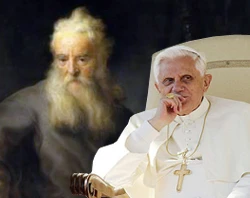
From 1828 to 1843, John Henry Newman (1801-1890) was vicar of St. Mary's Church in Oxford. He was not what we would call a "charismatic" preacher; he kept his eyes fixed upon his manuscript, never moving, looking at his congregation, or varying the tone or inflection of his voice.

It can be surmised that Obama wanted the meeting both as a matter of diplomatic propriety and to further enhance his legitimacy in the eyes of Catholics. The President is well aware of the divisions in the Catholic community, and he has proven himself a master of staffing his administration with Catholics who disregard the Magisterium of the Church. The degree to which such Catholics have chosen to ally themselves with Obama's programs is well illustrated by a recent feature story in Catholic World Report by Anne Hendershott:Obama and the Alternative Magisterium. All the more reason, then, to pray that the meeting with the Pope will be a different kind of "Catholic" experience for our President, an experience leading to conversion. One would also hope that Obama's contact with American bishops would be a catalyst for conversion. Unfortunately, some bishops still get sidetracked into dubious political issues, as when the head of the USCCB's Committee on International Justice and Peace wildly endorsed an enormously expensive piece of legislation designed to reverse global warming: US Catholic hierarchy shows support for legislation requiring massive tax hike. The reality is that something far worse than global warming is at work in our culture. I refer to continuing moral and spiritual deterioration, which really is the province of the bishops. This deterioration is frequently promoted through the pervasive media influence which shapes us all. Here's a timely reminder of how carefully parents need to control their children's use of new means of social communication: Can Teens Stay Connected Without Losing Touch? Combating these influences is most successfully done by actually developing a counter-culture. I've been reflecting (again) on what this means. Here are my latest ideas on How Culture Is Done.


Pope on Facebook in attempt to woo young believers
VATICAN CITY (Reuters) - You won't get an email saying Pope Benedict added you as a friend and you can't "poke" him or write on his wall, but the Vatican is still keen to use the networking site Facebook to woo young people back to church.
A new Vatican website, www.pope2you.net, has gone live, offering an application called "The pope meets you on Facebook," and another allowing the faithful to see the Pope's speeches and messages on their iPhones or iPods.
The Vatican's World Communications Day this Sunday is devoted to communicating the gospel with new technologies.
"We recognize that a church that does not communicate ceases to be a church," said Monsignor Paul Tighe, secretary of the Vatican's Social Communications department.
"Many young people today are not turning to traditional media like newspapers and magazines any more for information and entertainment.
"They are looking to a different media culture, and this is our effort to ensure that the Church is present in that communications culture."
Users of the new site can select from more than a dozen "virtual postcards" with pictures of the pope and messages from him on faith, love and life specifically aimed at young people, and send them to other users.
The Catholic Church, which has seen vocations to religious life decline and church attendance fall, has already turned to the Internet.
Last January the pope became one of the oldest people to have his own YouTube channel, www.youtube.com/vaticanit.
The pope, known to write most of his speeches by hand, while his aides manage his forays into cyberspace, has even admitted that the Vatican does not use the Internet enough.
The Vatican got egg on its face in January when the pope admitted that, if the Church had surfed the web more, it might have known that a traditionalist bishop whose excommunication was lifted had for years been a Holocaust denier.
Vatican launches Facebook application
Web surfers can now send virtual postcards of Pope Benedict XVI to their Facebook friends or follow the pontiff's travel on their iPhones.
Under a papacy that has suffered communication woes, the Vatican is taking new, technologically savvy steps to bring its message to social networking sites and smartphones.
In its first day of operation Thursday, the Pope2You portal gathered some 45,000 contacts and 500,000 page views, while a Facebook application that sends postcards with photos of Benedict and excerpts from his messages was used around 10,000 times, the head of the project said.
Also available on the portal is an application for iPhone and iPod Touch that gives surfers video and audio news on the pope's trips and speeches, as well as on Catholic events worldwide.
.jpg)